
This is also available in Swedish.
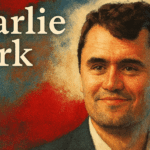
Charlie Kirk was murdered on September 10th.
His name was virtually unknown to me before I randomly landed on his Facebook page. I knew he was a conservative debater, but that was about it. I looked around and he seemed like an interesting guy, so I clicked Follow. Just a few hours later a friend told me Charlie Kirk had been shot.
Shockwaves
Charlie Kirk’s death affected many people deeply, including myself. It made big headlines and produced loads of articles and videos. It has not been like other similar high-profile deaths. Why is that? I can think of a few reasons:
First, Charlie was a prominent public figure and opinion maker. He was widely appreciated, so his death hit home for many.
Second, Charlie’s death was public, brutal, and sudden. It occurred in the middle of his tour without any warning or time to prepare. His death was swiftly broadcast over the entire internet. Had the killer come to his home and killed him on his doorstep, the impact would not have been so widespread.
Third, Charlie was killed for his views; he was targeted not for anything he had done but for what he had said. This should not happen in a free and democratic society. Charlie Kirk was a fierce defender of free speech and debate. He famously said, “when we stop talking, we start fighting.” Others saw him very differently, labeling him as a provocateur and an extremist.
Algorithms and legacy
Many have remarked that depending on the algorithms, you may have seen different versions of Charlie Kirk in your feed. There are certainly many good examples of Charlie Kirk being gentle and kind towards his opponents. At the same time, there are numerous allegedly outrageous statements of his. Though many of these are actually not outrageous at all (e.g. his recurring denunciations of abortion) or else exaggerated and clearly taken out of context, there remain several remarks relating to racial issues that are difficult. How do we reconcile this? Actually, I don’t think we have to. Throughout Scripture people are praised or known for being godly, while at the same time demonstrating huge areas of sin and oversight in their lives (Noah, Abraham, David, Peter, to name a few). We don’t need to excuse or ignore the sin, nor do we need to defame their faith. People are complicated. Sin yet lingers in all of us. While the media and the internet are filled with pundits and förståsigpåare – self-styled experts eager to explain everything. We can and should resist that urge. We don’t need to defend Charlie Kirk in everything, nor do we need to account for everything he said and did. Charlie was Charlie. Most importantly of all: Charlie was a Christian.
Charlie was not a vocational evangelist or pastor but he did believe in Jesus Christ. Faith was central to his political mission and he often shared the gospel publicly with his audience. We may not agree on everything he said and stood for but we should recognize the larger aim: he desired to call the people of America back to faith, church, and family. Oh, how I long to see this in the Nordics!
Courage required
In an interview earlier this year, Charlie Kirk said he would want to be remembered for courage for his faith. As Western Christians, we need some of that courage—perhaps especially those of us in the Nordic countries! As our society has descended further into progressivism and the pressure to conform to its agenda is steadily mounting, it can be tempting to retreat and to avoid speaking on contentious issues such as abortion or transgender ideology. One might say the church should focus on the core tenets of the faith and leave the rest aside. However, history makes plain that silent retreat has never spared the church. Persecution has traditionally come not because of what Christians profess and believe, but rather for their refusal to participate in or endorse cultural or religious practices that contradict their convictions. If persecution comes to our part of the world, it will likely not be because we preach Christ but rather because we refuse to bow down to the demands of the prevailing cultural agenda.
If persecution comes to our part of the world, it will likely not be because we preach Christ but rather because we refuse to bow down to the demands of the prevailing cultural agenda.
The plans of the Lord
I have thought several times over the past month, What if Charlie Kirk had survived? What about all the good he could have done had he been given more years on this earth? Such a waste! Yet remember: our Lord is on the throne and nothing happens that he doesn’t allow. God can raise up others with even stronger boldness and conviction than Charlie Kirk. He did not die in vain. The plans and purposes of the Lord will not be thwarted. He raises up, he brings low, and still his word and truth endure.
At the memorial the gospel was proclaimed (even by leading politicians—imagine that happening in the Nordics!). Most powerful was of course the speech by Charlie’s widow where she forgave her husband’s murderer, saying “That man … I forgive him.” That is not only the gospel preached but the gospel lived. Because of Charlie’s death, millions of people were exposed to the gospel for the first time. Tim Allen (famous actor) tweeted he was moved to forgive his father’s killer after 60 years. Many people are coming to Christ right now.
A turning point
This moment may prove to be a turning point (a fitting name for Charlie Kirk’s organisation), and in more ways than one. Perhaps progressivism will be exposed for what it is—a hollow denial of reality—so that the shift towards conservatism gains momentum. Perhaps God will use Charlie’s death to strengthen the resolve of the people of God, giving us the courage to boldly proclaim the gospel to the ends of the earth. Perhaps it will even spark another great revival.
Remember: our Lord is on the throne and nothing happens that he doesn’t allow. God can raise up others with even stronger boldness and conviction than Charlie Kirk. He did not die in vain.
This moment may also mark a darker turning point. It may further exacerbate the already toxic polarization plaguing our western climate of debate. The same algorithms that spread the gospel also amplify outrage and reward contention and hostility. The more engagement, the wider the spread. This moment may harden narratives, provoke some to retaliate and encourage tightened controls. It may even signal a new era where Christians are met not only with lethal rhetoric but also with lethal force.
The way ahead
So what should we do now?
Let us not despair because the Lord is still on the throne and even when it looks dark, we must remember that the battle is already won (John 16:33)!
Let us not retaliate for our battle is not “against flesh and blood, but against the cosmic powers over this present darkness, against the spiritual forces of evil in the heavenly places” (Eph. 6:12).
Let us not hate for “Christ suffered for you, leaving you an example, so that you might follow in his steps” (1 Pet. 2:21). No, let us love. “Love your enemies and pray for those who persecute you” (Matt. 5:44).
Let us take inspiration from Charlie Kirk and be courageous and bold in our proclamation of truth, resolving to preach the gospel, in season and out (2 Tim 4:2).
Collin Hansen delivered an important message at the recent TGC Norden 2025 Conference about not presuming on the extraordinary acts of God, but to be obedient in the everyday ordinary tasks and labors. What shall we do, now that Charlie Kirk has died? In a sense the answer is Business as Usual. Let us continue praying to God for our neighbors, our churches, and our countries. Let us continue studying the Word of God and let us continue preaching the Word. Finally, let us love because that’s how our Lord told us the world would know that we are his disciples.
Let us also do as was noted in Turning Point’s heart-wrenching statement the day after his passing: let us look forward to meeting the gaze of our Lord Jesus Christ. Charlie Kirk is a reminder for us all that this day can sometimes arrive sooner than we think.