This article was originally published in Norwegian.
“My house shall be called a house of prayer” (Matthew 21:13).
At a time when the values of society are being challenged on multiple fronts—from the expansion of abortion legislation to increasing secularization in schools and public debate—Norway stands at a spiritual crossroads. Many feel that Christian values are being marginalized and that the Christian faith is being pushed out of the public sphere. At the same time, there is a growing longing for something deeper: a restoration of God’s presence in the nation and the unshakeable security and truth of the Bible. Amid this time of upheaval, a call is rising – not to protest but to pray. All of Norway Prays 2026 is not only a response to social developments but also an invitation to return to the Source. When Norway is shaken by cultural and moral upheavals, it is time for God’s people to stand together—not in fear, but in faith. For as Jesus said, “My house shall be called a house of prayer.”
A national prayer initiative
Prayer is the very breath of Christian life. For the believer, it is not a duty but rather a privilege. It is a sacred invitation to enjoy God’s presence, cooperate with him and carry out his will for the world. In light of this, the initiative All of Norway Prays 2026 is a national call to prayer revival, with the vision of covering Norway in continuous intercession around the clock throughout the year 2026. This prayer initiative is not just an organizational project but also a response to God’s heartbeat for the nation. Inspired by the prayer movement and rooted in the Bible, this article discusses the power and significance of prayer and its potential consequences for the church and Norwegian society.
Biblical basis for prayer
The Bible repeatedly testifies to the central place of prayer in God’s plan. Jesus himself modeled a life of prayer and taught his disciples to seek God with perseverance and faith. In the Sermon on the Mount, Jesus says: “Ask, and it will be given to you. … For everyone who asks receives, and he who seeks finds, and to him who knocks it will be opened” (Matthew 7:7-8). These are not empty promises but expressions of a relationship in which God answers prayer according to his will.
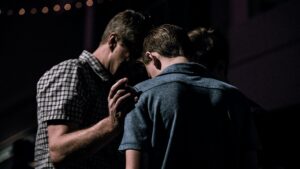
Prayer is an invitation to deep unity with God and with one another.
James 5:16 emphasizes the power of prayer when he writes that “the prayer of a righteous person has great power and effect.” He refers to the prophet Elijah as an example: “He was a man just like us. He earnestly prayed that it would not rain, and for three years and six months there was no rain on the earth. Then he prayed again, and the heavens gave rain” (James 5:17-18). Here, a profound theological truth is highlighted: God works in tandem with people in prayer. As Timothy Keller says, “without God we cannot, without us he will not”.
E.M. Bounds points out that prayer involves the whole person: thoughts, emotions, will, and spirit. It is not an intellectual exercise, but a wholehearted surrender. Prayer is not primarily about getting things from God, but about being shaped after his own heart. Jesus himself prayed, “Not my will, but Yours be done” (Luke 22:42) and in the Gospel of John, he prays for believers that “they may all be one, just as You, Father, are in Me and I am in You” (John 17:21). Prayer is an invitation to deep unity with God and with one another.
When Jesus cleansed the temple in Matthew 21:13, he quoted Isaiah 56:7, saying “My house shall be called a house of prayer.” The temple was to be a place for an intimate relationship with God. In the new covenant, the believer himself is God’s temple. As Paul reminds us: “Do you not know that your body is a temple of the Holy Spirit within you?” (1 Corinthians 6:19). Thus, prayer becomes not just an activity but also a lifestyle of intimacy and reminds us of our identity in Christ.
The Vision: All of Norway Prays 2026
Prayer has a deeply personal dimension. In my own life, prayer has been a source of transformation—from restlessness to rest, from control to surrender. Prayer has been the place where I have surrendered my worries, sought God’s guidance and experienced concrete help—both in the form of healing and wisdom. Even more important has been experiencing God as my Father. In the silence when words fail me, I have felt God’s loving presence and been reminded of who I am in him. Prayer has become my anchor and my strength—a place of transformation, not only of circumstances but even more so of my own heart.
The Norwegian prayer initiative is a vision to gather all of God’s people—young and old and across denominations—in a national prayer revival. Throughout 2026, Norway will be covered in continuous prayer. Churches, youth ministries and organizations are challenged to take responsibility for days or weeks in the prayer calendar by establishing prayer rooms, prayer walks and creative forms of prayer. The platform www.helenorgeber.no will offer digital resources, booking solutions and manuals for prayer.
The experiences from Hele Rogaland ber i 2024 (All of Rogaland Prays in 2024) give a strong picture of what prayer can accomplish. Over 600 people from 50 different churches participated, and concrete answers to prayer were reported. As an example, a school that had previously rejected Christian work opened its doors to a Christian school team. In Gand Church, prayer walks were organized throughout the parish while the young people in Riska Church established their own prayer room. At Tryggheim VGS, a day of prayer was organized and the fruits were recognized both spiritually and in community-building.
Throughout 2026, Norway will be covered in continuous prayer.
The possible consequences of prayer for Norway
A national prayer movement such as All of Norway Prays 2026 can have several profound consequences. Firstly, it could lead to spiritual renewal. When God’s people gather in persistent prayer, something happens both in their hearts and in the community. Wesley and Stacy Campbell describe prayer as a movement of passion. “Passion breeds passion—just like David’s dance.” When the Holy Spirit touches God’s people, life is restored and the church is awakened to new life.
Secondly, prayer can lead to greater unity in the church. Prayer transcends doctrinal and confessional divisions. In the presence of God, differences become secondary to his love. Historically, prayer movements have often been catalysts for reconciliation and cooperation among Christians.
Thirdly, prayer has a diaconal dimension. James 1:27 reminds us that as Christ-followers, we should strive to “help orphans and widows in their distress and to keep ourselves unstained by the world.” Prayer that does not lead to action is incomplete. A prayer revival will therefore inevitably awaken a new need for justice and charity as our will is shaped more according to God’s good will.
Finally, prayer can lead to social change. Christian faith has historically been a driving force behind reforms in education, healthcare, and politics. When God’s people seek him for the nation, something happens in the unseen world—which in turn can and will have visible consequences. At a time when abortion laws are being expanded and schools are being infiltrated by both gender confusion and secularization, we need God’s renewal in society more than ever.
Concluding thoughts
Prayer is more than words. It is a relationship leading to struggle and transformation. Prayer is both our response to God’s initiative and our tool for advancing his kingdom. The Bible teaches us that prayer can close heaven–and open it (James 5:16-18). All of Norway Prays 2026 is an opportunity to see a new wave of spiritual life, unity and societal transformation in our country. Now is the time to come together in prayer—with perseverance, faith and love.
References
Batterson, M. (2011). The Circle Maker: Praying Circles Around Your Biggest Dreams and Greatest Fears. Zondervan.
Bibel 2011. (2011). Det Norske Bibelselskap.
Bounds, E. M. (1990). The Complete Works of E. M. Bounds on Prayer. Baker Pub Group.
Campbell, W., & Campbell, S. (2002). Bibelbønn. Proklamedia
Keller, T. (2016). Prayer: Experiencing Awe and Intimacy with God. Hodder Faith.